
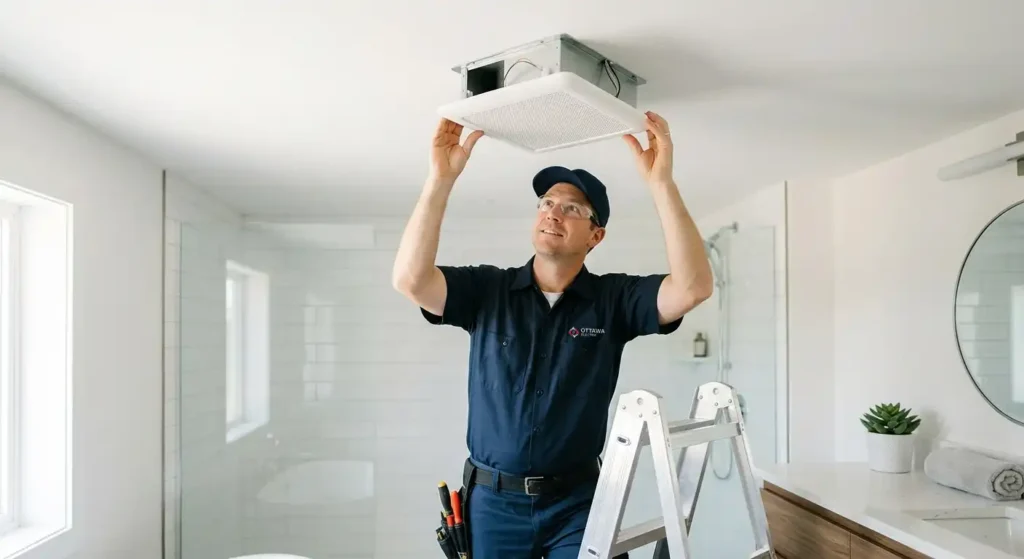
Bathroom Fan Installation in Ottawa:
DIY or Call an Electrician? (2026 Guide)

Bathroom Fan Installation in Ottawa DIY or Call an Electrician Guide

We are standing under a bathroom ceiling, screwdriver in one hand, phone in the other. The old fan is either dead, barely working, or louder than a jet engine. We are one minute away from a decision: grab the ladder, or call a pro.

That one decision has real stakes. Get it right, and we save a few hundred dollars on a Saturday afternoon. Get it wrong, and we end up with hidden mould, a tripped breaker, or a wiring problem that shows up two winters later.

This guide is the straight answer. We walk through what Ontario law actually says, the warning signs that mean stop, a short interactive test we can run right now, and what proper bathroom fan installation really looks like in Ottawa. By the end, we know exactly which side of the line our project is on.

Bathroom Fan Installation in Ottawa Guide

What your bathroom fan is really supposed to do

Before we decide who should install the fan, let us get honest about what the fan is there for in the first place.

A bathroom exhaust fan is not a luxury. It is a moisture-control tool. Health Canada recommends keeping indoor humidity between 30% and 50% to protect against mould and poor air quality. In a small bathroom with a hot shower, humidity can spike past 80% in minutes. The fan is what pulls it back down.

The Home Ventilating Institute gives us a simple sizing rule: 1 CFM of airflow for every square foot of bathroom, with 50 CFM as the floor for small bathrooms. They also recommend running the fan for 20 minutes after the shower ends — not just while the water is running.

CFM Sizing: Match the Fan to the Bathroom

Home Ventilating Institute recommended minimums

Under 50 sq ft
50 CFM
Powder room
50–75 sq ft
50–75 CFM
Small half-bath
75–100 sq ft
75–100 CFM
Standard full bath
100+ sq ft
150+ CFM
Master ensuite
The real point: a fan that looks fine on the box can still fail in practice. Why? Because installation quality matters more than specs. That is where the DIY question starts to get interesting.

The 3-question test: is this a simple swap or not?

Here is the fastest way to know if a job might be DIY-safe. We ask ourselves these three simple questions before we even open the old fan.

  1. Existing fan — is there already a working bathroom fan in the exact spot?
  2. Same size — are we replacing it with a fan of similar size and power draw?
  3. Outside vent — does the existing duct vent to the outside, not the attic?

Three clean "yes" answers? We are in like-for-like replacement territory. DIY is a fair option for anyone comfortable turning off a breaker and connecting three wires.

Even one "no" changes the picture. The job is no longer a simple swap. We are now dealing with new wiring, new ducting, or a new hole through the roof or wall. That is the point where most of our Ottawa electrician calls start.

Not sure where you land on the 3-question test?

We will take a look, answer your questions, and give you a straight quote — no pressure.

Same-Day Quote

Matt Fortin certified electrician ottawa Ontario

When "just replacing a fan" quietly turns into electrical work

A homeowner on Reddit once posted a photo of his ceiling with the caption "trying to install bathroom fan." When he opened the switch box, there was no power at the switch itself. What he had was something called a switch loop — the power actually runs through the ceiling box, not the wall.

Bathroom fan switch loop wiring

He thought he was doing a 45-minute swap. He ended up needing a real rewire.

This kind of surprise is common in Ottawa. Older bungalows, 1970s split-levels, and homes that have seen a few renovations love to hide things. If we pull the old fan down and see anything unfamiliar, it is always safer to book a quick assessment before going any further.

A few patterns quickly turn a "swap" into a real electrical job:

  1. No existing fan at all — a new circuit and new wiring are needed
  2. Fan-light-heater combo upgrade — different amp draw, different wiring rules
  3. Aluminum wiring — common in Ottawa homes built between 1965 and 1975
  4. No ground wire — or wires not rated for a damp location

What Ontario law actually says about DIY electrical work

Most homeowners do not realize Ontario has firm rules about this. It is worth knowing them before we pick up a tool.

According to the Electrical Safety Authority (ESA), all new electrical installations in a home require a notification before the work starts. The ESA is also clear that the basic homeowner exemption does not cover installing, extending, altering, or repairing wiring. In plain English: if we are adding new wiring for a new fan, we need to file an ESA notification.

The City of Ottawa layer is worth knowing too. Ottawa building permits do not cover work that is purely electrical. That side of things is handled through ESA, not city hall. So when a neighbour says "just pull a city permit," they are looking at the wrong office.

If we are doing a like-for-like swap with no new wiring, the rules are lighter. But the moment we add a new circuit, we are either filing a notification ourselves or handing the work to a licensed pro who does it every day.

The DIY exemption trap: homeowners often assume the exemption covers anything inside their own house. It does not. The moment wiring is installed, extended, or altered, the notification rule kicks in — and skipping it can void home insurance if something goes wrong later.

The ducting trap most DIYers fall into

Here is the hidden reason many DIY bathroom fan jobs go sideways. It is not the wiring. It is the duct.

The U.S. Department of Energy's Building America guide says bathroom exhaust ducts should vent outside — never into the attic or crawlspace. Ducts should be short, straight, insulated, and made of smooth metal, with as few elbows as possible. The guide is blunt: venting into an attic causes mould, rot, and eventual wood damage.

The problem? Most DIY bathroom fan jobs use cheap flex duct, add three bends to work around a rafter, and end at an unsealed attic vent. On paper, the fan is rated for 80 CFM. In real life, it is moving closer to 30. That is how homes end up with mouldy rafters even though the fan "works."

✓ Correct
Short, insulated, outside
  • Rigid 4-inch metal duct
  • Under 15 feet total length
  • Gentle 45° turns, not 90°
  • Insulated through attic
  • Terminates outside with backdraft damper
✕ Wrong
Cheap, bendy, indoors
  • Corrugated plastic flex duct
  • 25+ feet of sagging hose
  • Three or more sharp 90° bends
  • Bare hose in cold attic
  • Dumps into attic or soffit cavity
The fix is not fancy: insulated, rigid, 4-inch metal duct. Keep the run under 15 feet. Use gentle 45-degree turns instead of sharp 90s. Terminate outside with a backdraft damper and insect screen. That is it.

If the attic looks like a nest of dusty corrugated hose, we have just found the real reason the bathroom still feels damp.

Suspect a ducting problem behind your fan?

Bad ducting is the #1 reason bathroom fans underperform. We will inspect it and tell you straight.

Same-Day Quote

Matt Fortin certified electrician ottawa Ontario

Your interactive decision guide

Here is the fastest way to get a personal answer. We walk through the questions below, and based on the answers, we see whether the job is DIY-friendly, a caution zone, or a clear pro call.

Bathroom Fan Install: DIY or Pro?

Answer 5 quick questions for a tailored recommendation.

Cost comparison: DIY vs electrician in Ottawa

Let us talk dollars. Here is what we see in the Ottawa market in 2026.

Scenario DIY cost (parts) Professional cost What drives the difference
Like-for-like fan replacement $60 – $250 $250 – $500 Clean wiring + existing duct = DIY-friendly
New fan install (no existing fan) $150 – $400 + risk $650 – $1,500 Requires ESA notification + new circuit
Fan + light + heater combo $200 – $500 + risk $800 – $1,800 Higher amp draw changes wiring needs
Proper duct re-run + exterior venting $80 – $200 + risk $400 – $900 Skill-heavy; often the real fix needed

DIY looks cheaper on paper. It stops looking cheaper the moment we factor in a second trip to the hardware store, a ruined ceiling, or a hidden moisture problem that only shows up two winters later.

Red flags that mean "stop and call a pro"

If any of these show up while we are inspecting the space, we stop where we are. These are not DIY situations. These are safety situations.

  • Discoloured, brittle, or cloth-covered wire insulation — a sign of very old wiring that can fail under new load
  • Aluminum wiring — common in Ottawa homes built between 1965 and 1975, requires special connectors
  • Fan rated for more amps than the existing circuit can handle — a breaker trip waiting to happen
  • Burn marks, melted plastic, or soot around the old fan housing — a fire-hazard flag, not a cosmetic issue
  • Active water staining or drywall swelling around the fixture — there is a bigger problem to find before the fan goes back in

Any one of these is a reason to close the ceiling back up and call a licensed electrician. A fifteen-minute site visit costs much less than fixing a fire hazard.

Seeing a red flag in your ceiling?

Do not push through it. A quick visit from a licensed Ottawa electrician is always cheaper than the alternative.

Same-Day Quote

Matt Fortin certified electrician ottawa Ontario

The Ottawa winter factor nobody warns you about

Here is a detail most DIY guides from warmer cities skip. In January, when it is –25°C outside and 22°C inside the bathroom, cold ducts sweat. Water drips back down through the fan grille. Frost can build up inside the duct and quietly block airflow for weeks.

–25°C
Ottawa January lows where duct condensation starts
47°C
Temperature gap between bathroom air and attic duct — where sweat happens

This is why bathroom fan installation in Ottawa needs extra attention to two specific things: duct insulation and a working backdraft damper. A bare, non-insulated duct sitting in an unheated attic is basically a condensation machine.

If we have ever seen a water stain form a ring around the bathroom fan in winter, that is the cause. The fix is usually a duct re-wrap and a proper exterior hood — not a new fan. Many Ottawa homeowners replace a perfectly good fan when the real culprit is six feet of bare flex duct above the ceiling.

The hidden diagnostic: if the stain is worst from December through February and fades by April, it is almost certainly a duct condensation issue, not a roof leak. A roof leak would stain in any season with heavy rain.

What a proper bathroom fan installation looks like

When our team takes on an exhaust fan installation, here is what the process looks like from start to finish. Every step is non-negotiable on our jobs.

  1. Assess the current setupWiring, circuit load, existing duct path, and any signs of past moisture damage or unsafe work.
  2. File the ESA notificationFor any new wiring work, we file with ESA before the job starts — not an optional step in Ontario.
  3. Size the fan properlyMatch CFM to the bathroom square footage and select a quiet model (1.0 sones or less) that the homeowner will actually run.
  4. Install and wire to codeMount the housing securely to the joists, wire it to current OESC standards, and test every connection.
  5. Run short, insulated, rigid ductSmooth 4-inch metal duct, under 15 feet total, with insulation through any unheated space — straight to the outside.
  6. Seal, test, and hand offSeal all joints, verify airflow with a real meter, clean up, and walk the homeowner through the controls and timer settings.

No attic venting. No corrugated flex duct. No guessing on wire gauge or breaker size. That is the standard we aim for on every residential job we take on in Ottawa — whether it is a full bathroom fan installation or a careful like-for-like replacement.

The bathroom fan is a small fixture, but the work behind it protects the ceiling, the attic, the air quality, and the resale value of the whole home. Worth doing right the first time.

FAQs

Yes. Roomside retrofit models from brands like Panasonic and Broan-NuTone are designed to be installed entirely from below. They are a strong option for second-floor bathrooms in older Ottawa homes where the attic is finished or impossible to reach.

Not usually for a clean like-for-like swap. But new wiring or a brand-new installation requires an ESA notification. The City of Ottawa does not handle purely electrical work — that all goes through ESA.

A good rule of thumb is 1 CFM per square foot, with 50 CFM as the minimum. For a 60-square-foot bathroom, aim for a 60–80 CFM bathroom ventilation fan.

Almost always a cold, uninsulated duct — not a roof leak. The fix is to insulate the duct properly and make sure the exterior cap is sealed and working.

The Home Ventilating Institute recommends 20 minutes. A humidity-sensing switch or timer switch makes this automatic, which is one of the easiest upgrades you can make.

Share on Social Media:

Hey! I’m Matt Fortin, Founder & Master Electrician of Ottawa Electric. I have 20+ years of electrical industry experience across residential, commercial, and heavy industrial work. I lead our team with a focus on safety, quality workmanship, and clear communication.

Table of Contents
Picture of Matt Fortin
Matt Fortin

Same-day Quote

Ready to get your bathroom fan done right?

Ready to get your bathroom fan done right?

Whether it is a simple swap, a new install, or a mouldy duct problem you have been ignoring — we will sort it out properly the first time. Licensed, local, and no guesswork.

Same-Day Quote

Bathroom Fan Installation in Ottawa DIY or Call an Electrician Guide