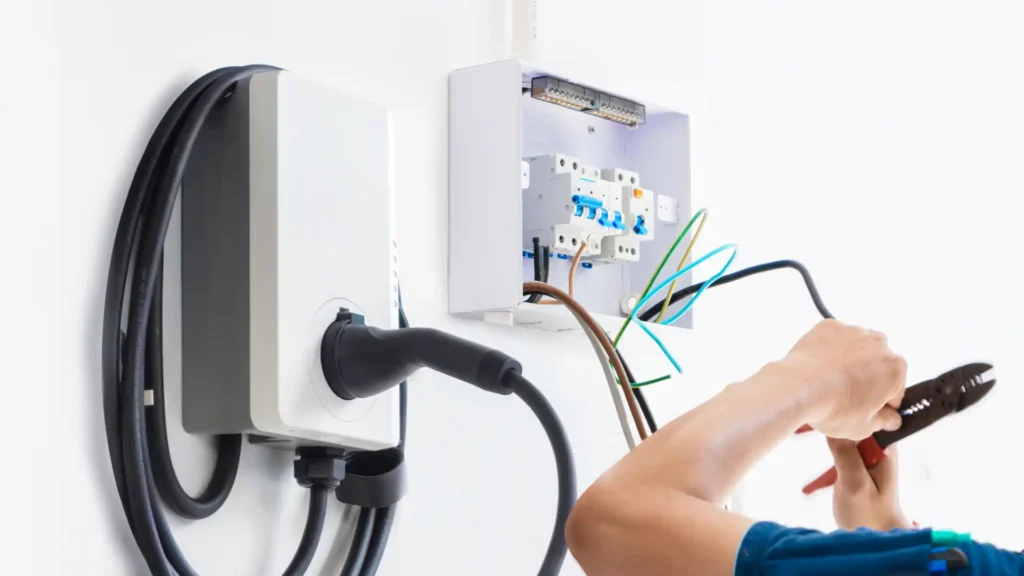
Best EV Charger Installation Company in Ottawa
What Actually Matters
- 12 min read
- Published on:
- Updated on: May 19, 2026
- 12 min read
- Published on:
- Updated on: May 19, 2026

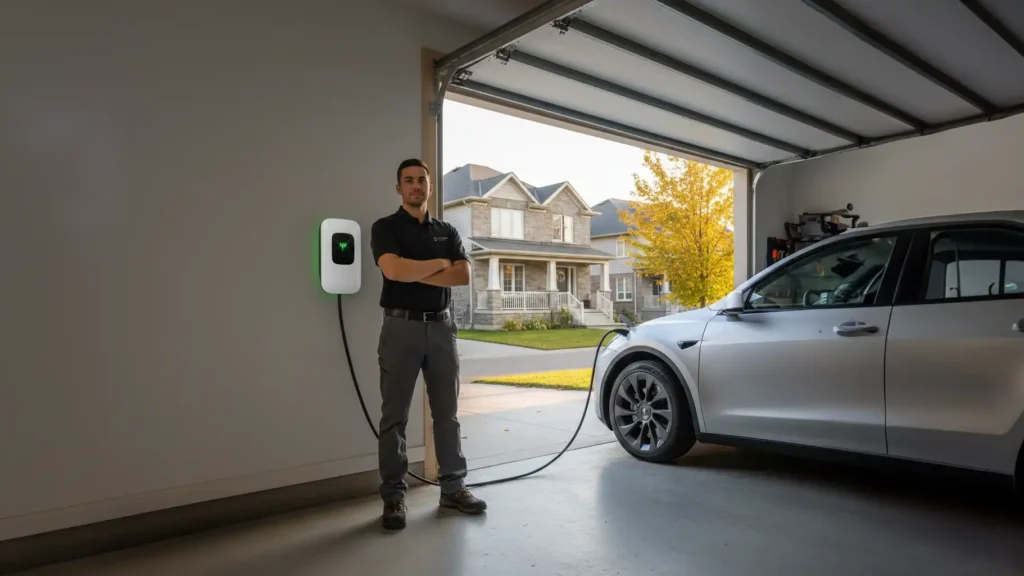
You bought an electric vehicle. Now you need a charger at home. And somewhere between “this should be simple” and “why is this quote $8,000?” things got confusing. We get it. This guide cuts through the noise and shows you exactly what separates a good EV charger installation company from one that cuts corners.
Here’s the thing most homeowners miss: the charger itself is the easy part. What really matters is what happens before someone plugs it in. Does your panel have room for a 40-amp circuit? Will the wire run through finished walls or open basement? Is your service 100 amps or 200? These questions determine whether your install costs $1,200 or $6,000.
We’ve installed hundreds of home EV chargers across Ottawa, Kanata, Orleans, and Barrhaven. Along the way, we’ve seen what goes wrong when homeowners hire the cheapest quote without checking the basics. This guide shares what we’ve learned—so you can make a smart choice for your home.
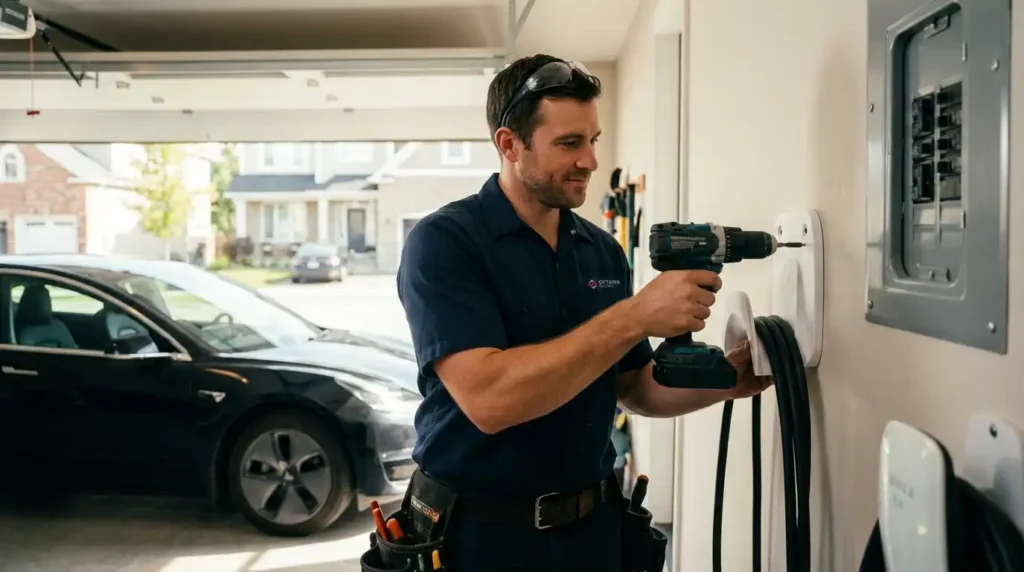
The Three Non-Negotiables for Ontario EV Charger Installs
Before we talk about choosing a company, let’s cover what Ontario law actually requires. These aren’t suggestions. They’re the rules that protect your home, your insurance coverage, and your family’s safety.
1 Every Install Needs an ESA Permit
The Electrical Safety Authority (ESA) requires a permit—technically called a “notification of work”—before any EV charger installation begins. Not after. Before. This applies whether you’re doing the work yourself or hiring someone. A company that says “we can skip the permit to save you money” is putting your home at risk.
2 Hired Work Must Be Done by a Licensed Contractor
In Ontario, anyone you pay to do electrical work must hold an ECRA/ESA licence. This isn’t about credentials for show—it’s about accountability. A licensed contractor carries insurance, follows code, and stands behind their work. If something fails, you have recourse. With an unlicensed installer, you have nothing.
3 Hired Work Must Be Done by a Licensed Contractor
Ontario’s Electrical Safety Code was updated in May 2025 with new requirements. Any installer working in Ottawa today needs to know these changes. Ask them directly: “Are you up to date on OESC 2024?” If they hesitate, that tells you something.
- Installer holds valid ECRA/ESA licence (verify at esasafe.com)
- Permit filed before work starts
- Final inspection arranged after completion
- Work follows 2024 Ontario Electrical Safety Code
These three requirements form your baseline. Any company worth hiring handles all of this automatically. If you have to ask them to pull permits, look elsewhere. You can verify any contractor’s licence at the ESA’s official EV charging page. Our team manages the entire permit and inspection process for every EV charger installation in Ottawa—it’s just how proper installations work.
What Actually Drives EV Charger Installation Costs
The charger is usually the smallest part of your budget. A solid Level 2 unit runs $500 to $900. But installation? That’s where costs vary wildly. Here’s why two neighbours with identical chargers might pay very different amounts.
Scenario 1: The Best Case ($750–$1,500)
Your garage shares a wall with your electrical panel. The panel has spare capacity—at least 40 amps available. The wire run is short, maybe 15 feet. No walls to fish through, no trenching, no upgrades needed. This is the dream scenario, and it’s more common than you’d think in newer Ottawa homes built after 2000.
Scenario 2: The Typical Case ($1,500–$3,000)
Most Ottawa homes fall here. Your panel has room, but the wire has to travel through finished spaces. Maybe it’s a 40-foot run from the basement to the garage. Maybe it goes through drywall that needs patching afterward. Maybe the charger mounts outside and needs weatherproofing. These real-world factors add labour and materials.
Scenario 3: The Big-Jump Case ($3,500–$8,000+)
Your home still has a 100-amp service, and adding a 40-amp charger would overload it. Now you need a panel upgrade—or even a service upgrade from Hydro Ottawa. One Reddit thread from Ottawa homeowners showed quotes ranging from $4,000 to $8,000 just for the Hydro Ottawa portion of a 200-amp upgrade. Add electrician costs, and totals climb fast.
Select your options below to get a rough cost range for your Ottawa home.
👆 Select an option from each question above to see your estimate
Based on typical Ottawa Level 2 EV charger installations. Includes permit, materials, and labour. Charger unit not included.
This estimator gives you a ballpark. The only way to get an accurate number is a site visit where an electrician checks your panel, measures the run, and calculates your load. That’s why we offer free on-site estimates—no guessing, no surprises.
Our licensed electricians will assess your panel, measure the run, and give you a clear price—no hidden fees.
Same-Day Quote

How to Evaluate an EV Charger Installation Company
Here’s the framework we’d use if we were hiring someone else. Think of it as a scorecard. Companies that score high on these factors deliver installs that last. Companies that don’t often leave you with problems down the road.
| What to Check | Why It Matters | Red Flag |
|---|---|---|
| ECRA/ESA Licence | Legal requirement; insurance coverage | “We don’t need a licence for small jobs” |
| Load Calculation | Prevents overloaded panels and fires | Quote given without visiting your home |
| Permit Handling | Ensures inspection and code compliance | “We can skip the permit to save you money” |
| Photos of Past Work | Shows quality and attention to detail | No portfolio or only stock photos |
| Written Warranty | Protects you if something fails | Verbal promises only |
| Post-Install Testing | Verifies charger works correctly and safely | “Just plug it in and try it” |
The lowest quote usually wins by skipping one or more of these steps. Maybe they don’t pull a permit. Maybe they use undersized wire. Maybe they don’t do a load calculation and your breaker starts tripping after the first cold snap. The cost of fixing these mistakes always exceeds the “savings” from the cheap quote.
The Hidden Cost of Cheap Installs
We've been called to fix installs where the original installer used 8-gauge wire instead of 6-gauge, mounted chargers without proper weatherproofing, or wired circuits without GFCI protection. These "savings" cost homeowners $800–$1,500 to correct—and that's assuming no damage occurred first.
10 Questions to Ask Before Signing
Print this list. Use it when you call for quotes. The answers will tell you everything you need to know about whether a company is worth your trust.
- 1 Are you ECRA/ESA licensed? Verify at esasafe.com before hiring.
- 2 Will you pull the permit? Yes is the only acceptable answer.
- 3 Will you do a load calculation? This determines if your panel can handle the charger.
- 4 What wire gauge will you use? For 40-amp circuits, the answer should be 8-gauge or 6-gauge depending on distance.
- 5 Is the quote based on a site visit or phone estimate? Phone-only quotes miss critical factors.
- 6 What's included in the price? Charger, labour, materials, permit fees, inspection coordination?
- 7 How long will installation take? Most residential installs take 4–8 hours.
- 8 What warranty do you offer? Get it in writing.
- 9 Can I see photos of similar installs? Look for tidy work, proper labeling, and clean conduit runs.
- 10 Will you test the charger after installation? They should verify full charging operation, not just power.
A reputable company welcomes these questions. They’ve answered them hundreds of times. If someone gets defensive or vague, that tells you what working with them will be like.
Hardwired vs. Plug-In: Which Install Makes Sense?
This question comes up constantly. Both options work. The right choice depends on your situation.
Plug-In (NEMA 14-50 Outlet)
The electrician installs a dedicated 240V outlet. You plug the charger into it. If you move homes or upgrade chargers, you unplug and take it with you. Some chargers void their warranty if hardwired, so check your manual.
Best for: Renters, people who move frequently, chargers that require plug-in configuration.
Hardwired
The charger connects directly to your circuit—no outlet in between. This is often required by building codes for outdoor installations in Ontario. It’s also cleaner looking and eliminates any plug connection points.
Best for: Permanent installations, outdoor mounting, chargers designed for hardwiring, homeowners planning to stay long-term.
From a safety standpoint, both options work when installed correctly. The main consideration is flexibility versus permanence. We help homeowners think through this during every EV charger consultation.
Our electricians will check your load capacity and tell you exactly what’s possible—before you commit to anything.
Same-Day Quote
How Ottawa Homeowners Save on EV Charging Costs
Installing the charger is a one-time cost. Charging your car is ongoing. Here’s where Ottawa homeowners have an advantage most people don’t know about.
Hydro Ottawa's Ultra-Low Overnight (ULO) Rate
If you switch to ULO pricing, you pay just 3.9¢ per kWh between 11 p.m. and 7 a.m. That’s less than a quarter of the on-peak rate. For a typical EV that uses 300 kWh per month, that’s roughly $12 in overnight electricity versus $40+ during peak hours. The catch? Weekday daytime rates are higher, so ULO only makes sense if you can shift most electricity use to overnight—which EV owners naturally do.
| Time Period | ULO Rate (Nov 2025) | Best For |
|---|---|---|
| Ultra-Low Overnight (11pm–7am) | 3.9¢/kWh | EV charging, laundry, dishwasher |
| Weekend Off-Peak | 7.6¢/kWh | General use on Saturdays/Sundays |
| Mid-Peak | 12.2¢/kWh | Morning/evening weekdays |
| On-Peak (Weekday daytime) | 28.6¢/kWh | Avoid if possible |
You can compare all rate plans and switch online through Hydro Ottawa’s rate selection page.
Hydro Ottawa's EV Everywhere Pilot
This is a new program worth knowing about. If you enrol, Hydro Ottawa can briefly pause your EV charging during peak grid events—typically just 15–30 minutes at a time. In exchange, you get $15 per month in bill credits. For most people, you’d never notice the pause. Your car still charges fully overnight.
"The EV Everywhere pilot uses BluWave-ai technology to balance grid demand while rewarding participating homeowners. It's exactly the kind of smart charging Ottawa's grid needs as EV adoption grows."
— Hydro Ottawa, 2025
When we complete an installation, we make sure the charger is positioned to take advantage of these programs. Smart chargers with scheduling features pair perfectly with ULO rates—set them to start at 11 p.m. and you’ll maximize savings automatically.
Learn more about eligibility and enrollment at Hydro Ottawa’s EV Everywhere program page.
When You Need More Than an EV Charger Install
Sometimes a home visit reveals something the homeowner wasn’t expecting: the panel can’t support a new 40-amp load. This happens most often in homes built before 1990 with 100-amp service. Adding an EV charger, AC unit, and modern appliances pushes these systems past their limits.
If your electrician says you need a panel upgrade, here’s what that typically involves:
- 1 Load calculation to determine your actual needs (100A, 200A, or 400A)
- 2 Permit application through ESA
- 3 Hydro Ottawa coordination if your service needs upgrading (add 3–4 weeks)
- 4 Panel swap from old equipment to a modern breaker panel
- 5 Inspection before power is restored
Panel upgrades add $1,800–$4,000 to your project depending on complexity. Service upgrades from Hydro Ottawa add more. It’s a significant investment, but it future-proofs your home for EV charging, heat pumps, and whatever comes next.
Installing EV Chargers in Ottawa Condos and Townhomes

Condo dwellers face extra hurdles. You can’t just hire an electrician and start drilling—you need board approval, and sometimes building-wide infrastructure planning. Here’s what we’ve seen work.
Step one is always the board. Present your request formally. Include information about load requirements, proposed charger location, and how you’ll handle installation costs. Clean Energy Canada’s 2025 guide “Make Your Condo EV Ready” is an excellent resource for this conversation. It covers phased rollouts, energy management systems that reduce upgrade costs, and billing approaches for shared infrastructure.
Energy management is the key to affordability. If ten units each want 40-amp chargers, the building doesn’t need 400 extra amps. Smart energy management systems rotate charging across units, reducing peak demand and avoiding massive infrastructure upgrades. This approach can cut building-wide costs by 50% or more.
For individual unit owners, the process usually looks like this: get board approval, hire a licensed electrician familiar with condo work, coordinate with the property manager for access to electrical rooms, and ensure all work gets inspected. The complexity adds time, but the result is the same—a safe, code-compliant charger at home.
Making Your Decision
Choosing the best EV charger installation company in Ottawa comes down to fundamentals. Are they licensed? Will they pull permits? Do they calculate your load before quoting? Will they show you past work? These basics separate professionals from shortcuts.
The investment pays off quickly. Home charging costs roughly 70% less than public stations. With Hydro Ottawa’s ULO rates, that gap widens further. And unlike a gas station trip, your car charges while you sleep. Over the life of your vehicle, home charging saves thousands of dollars and countless hours.
We’ve been installing EV chargers across Ottawa since before they were mainstream. Our team handles the permit, coordinates with Hydro Ottawa when needed, and makes sure your installation works safely for years to come. If you’re ready to move forward—or just want to know what your home needs—request a free estimate and we’ll take it from there.
FAQs
How long does a home EV charger installation take?
Do I need a permit for EV charger installation in Ontario?
What amp service do I need for a Level 2 EV charger?
Can I install an EV charger myself in Ontario?
Legally, yes—homeowners can do their own electrical work in Ontario. However, you must still file an ESA permit before starting and have the work inspected. Given the complexity of 240V circuits and the safety stakes, most homeowners choose to hire a licensed electrician.
What's the best EV charger for Ottawa winters?
Look for chargers rated for outdoor use with operating temperatures down to -30°C or colder. Canadian-made chargers like Grizzl-E are designed specifically for our climate. For indoor garage installations, cold tolerance matters less—focus on amperage and smart features instead.
Share on Social Media:
Hey! I’m Matt Fortin, Founder & Master Electrician of Ottawa Electric. I have 20+ years of electrical industry experience across residential, commercial, and heavy industrial work. I lead our team with a focus on safety, quality workmanship, and clear communication.
Table of Contents

Ready to Charge at Home?
Join hundreds of Ottawa homeowners who trust Ottawa Electric for safe, code-compliant EV charger installations.
Same-Day Quote