Ottawa’s 2025 Smoke-Alarm Requirements
(Safe Homes, Clear Rules)
- 10 min read
- Published on:
- Updated on: July 28, 2026
- 10 min read
- Published on:
- Updated on: July 28, 2026


Quick Summary
Basic rule: Ottawa follows Ontario Fire Code – you need a working smoke alarm on every floor and outside each sleeping area. Homes built after 2014 also need alarms inside bedrooms that are all connected together.
Why 2025 matters: This year focuses on compliance and keeping good records. You need to test alarms monthly and document it, especially if you’re a landlord.
What to buy: Look for ULC-listed alarms (CAN/ULC-S531). Hard-wired or wireless connected alarms work best because when one goes off, they all go off.
Need help? Ottawa Electric can check your setup, install the right alarms, and give landlords a compliance report.
Why This Actually Matters
When a fire starts, you have seconds – not minutes. Alarms give you that critical head start.
The legal minimum is straightforward but often missed:
- One working alarm per floor
- One outside each sleeping area
- For homes built 2014 or later: alarms inside bedrooms that connect to each other (when one sounds, all sound)
Even if your home is older, interconnected alarms are a smart upgrade – they make sure everyone hears the warning, no matter where the fire starts.
Skip the guesswork: Ottawa Electric can check your placement, supply certified devices, and install interconnection so your alarms actually wake everyone when it matters most.
🚨 Check your smoke alarm setup
Answer four quick questions to identify possible gaps in your Ottawa home.
What type of property is this?
When was the home built or substantially renovated?
Which description best matches your alarm coverage?
What condition are the alarms in?
Recommended next steps
This checker identifies possible gaps only. Final requirements depend on the home, renovation history, layout, and applicable code.
Select an answer to continue
Educational tool only. It does not certify Fire Code compliance or replace an on-site assessment.
Understanding Ottawa's 2025 Smoke Detector Regulations
Ontario’s Fire Code forms the foundation, but Ottawa enforces it with particular attention to rental units and older homes. Here’s what changed and what stayed the same heading into 2025.

The Core Requirements That Apply to Every Ottawa Home
Every dwelling in Ottawa must have working smoke alarms installed on each storey and outside all sleeping areas (Ontario Fire Code 2022, Division B 9.10.19). That means if you have bedrooms on your second floor, you need at least one alarm in the upstairs hallway. If someone sleeps in your basement rec room, another alarm goes there too.
The detectors must be ULC-listed—that’s the Underwriters Laboratories of Canada certification proving the unit meets safety standards. You’ll see a small label on the back of approved models. Without that marking, your detector might work perfectly but won’t satisfy code requirements during inspections.
Ottawa Fire Services ramped up compliance checks in 2024, particularly targeting rental properties. Landlords now face escalating fines for non-compliant units, starting at $365 for first offenses and climbing with repeat violations (City of Ottawa By-Law 2024).
What's Different for Newer Homes vs. Existing Properties
If your home was built or substantially renovated after 1995, you likely need hardwired, interconnected smoke alarms. “Interconnected” means when one alarm detects smoke, all connected alarms sound throughout the house—giving everyone simultaneous warning regardless of where the fire starts.
Older homes built before these requirements get some flexibility. Battery-powered alarms remain acceptable, though Ottawa Fire Services strongly recommends upgrading to 10-year sealed lithium battery models. These eliminate the “chirping at 3 AM” scenario when your detector’s standard 9V battery dies.
Here’s the practical difference: if you’re replacing an old detector in a home built in the 1980s, a quality 10-year battery model satisfies code. But if you’re renovating your kitchen or adding a bedroom, that triggers the newer interconnection requirement for affected areas.
2025 Enforcement Focus: Rental Properties and Multi-Unit Buildings
Ottawa’s Fire Prevention Officers are prioritizing rental unit inspections throughout 2025. Why? Because tenants often assume landlords handle everything, while landlords sometimes believe tenants should manage maintenance. This gap creates dangerous situations.
The city now requires landlords to provide written documentation of smoke alarm installations and testing schedules. During routine inspections, officers verify not just that alarms exist, but that they’re properly placed, functional, and interconnected where required. Properties with repeated violations risk occupancy restrictions until compliance is achieved.
Rental properties in Ottawa: who does what?

Landlords must install, maintain, and ensure working smoke alarms that meet Code and labeling standards, keep testing/maintenance records, and give proper notice of entry for testing. Tenants must not disable alarms, should test monthly, and report issues promptly. Inspectors can issue tickets or escalate under provincial law for non-compliance.
Access for testing: Landlords provide notice; tenants provide access. Keep a short test log (date, location, result, action). It’s quick and pays off at inspection time.
Pro tip for landlords: Book a single visit with Ottawa Electric. We label each device, perform a full function test, and leave you a fillable compliance log—ready for inspections.
Professional Smoke Detector Installation in Ottawa
Get expert, ULC-listed smoke alarm installs—placed right, interconnected, and inspection-ready for Ottawa’s 2025 Fire Code.

Where to buy “approved” smoke alarms in Ottawa (and what to ask for)

In Canada, “approved” means ULC-listed. Look for ULC or cUL marks and the Canadian smoke-alarm standard CAN/ULC-S531 on the label. Ottawa retailers—Home Depot, Canadian Tire, RONA/Lowe’s, Home Hardware—carry photoelectric, ionization, combo smoke/CO, and smart models that meet Canadian standards. If you’re unsure, Ottawa Electric can supply, install, interconnect, and label everything in one visit.
Choosing the right tech (quick guide):
Photoelectric vs. ionization: Photoelectric typically reduces nuisance trips near kitchens and responds quickly to smouldering fires; ionization responds faster to flaming fires. Either is fine if ULC-listed; many Ottawa homes favour photoelectric in hallways near kitchens.
Combo smoke/CO: If you have fuel-burning appliances or an attached garage, you also need CO alarms near sleeping areas; combo units simplify placement.
Power & interconnection options:
Hard-wired, interconnected: Best for multi-storey or multi-unit homes; when one sounds, all do. Requires an electrician.
10-year sealed battery: Ideal for retrofits/rentals; tamper-resistant and no annual swaps.
Smart alarms: App alerts, self-testing, wireless interconnect, event logs—great for landlords (ensure ULC listing).
Wireless interconnect (battery): Practical in older homes without neutral wires; choose ULC-listed models.
Accessibility note: For residents who are deaf or hard of hearing, use ULC-listed visual alarms (strobe) and consider bed-shaker accessories in bedrooms for sleeping-hour alerts.
The basics: placement, testing, and end-of-life (mini step-by-steps)
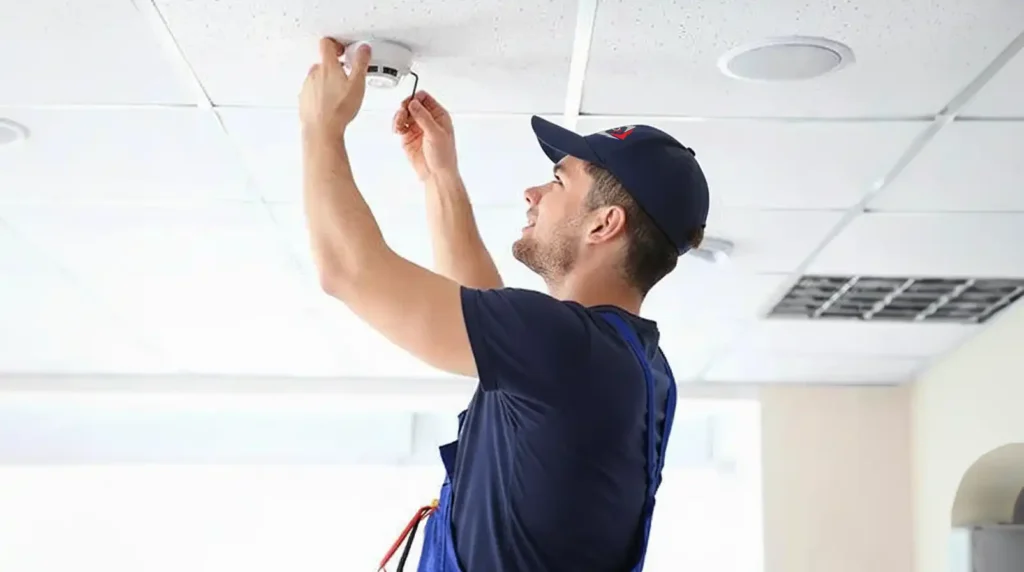
🏡 Placement (quick wins):
Install on ceilings or high walls—smoke rises. Place one on each storey and outside sleeping rooms; in 2014+ homes, also inside bedrooms. Keep alarms several feet from kitchens/bathrooms to reduce nuisance trips; avoid corners and supply registers where dead air can pool.
💡 Kitchen & garage tips:
Keep alarms ~3 m / 10 ft from cooking appliances; prefer photoelectric near kitchens/baths. Use a heat alarm (not smoke) in garages.
📅 Monthly testing habit:
- Press and hold the test button until it sounds.
- For interconnected or smart systems, follow the manufacturer steps so all units confirm.
- Log the date—especially important for rentals and multi-unit properties.
⚙️ Maintenance & end-of-life:
Most smoke alarms are 10-year devices. Replace at end-of-life or if a unit fails a test; for non-sealed models, change batteries annually and when chirps occur.
A quick comparison (choosing what fits your home)
| Type | Best For | Pros | Considerations |
|---|---|---|---|
| Hard-wired, interconnected | Multi-storey homes, legal suites, renovations | All alarms sound together; reliable; supports bedroom coverage | Requires electrician; higher upfront cost |
| 10-year sealed battery | Retrofits, rentals, older homes without neutral | No battery swaps; tamper-resistant; easy compliance | Interconnection needs compatible wireless models; replace whole unit at end-of-life |
| Smart (wired or battery) | Landlords; tech-savvy owners | App alerts, self-testing logs, wireless interconnect | Higher price; ensure ULC listing and check condo/building rules |
(Always confirm the device is ULC-listed (CAN/ULC-S531).)
High-rise & Condos: who handles what
Inside your suite, you (or your landlord) maintain the in-unit smoke/CO alarms. The condo corporation maintains corridor/common-area fire protection. If your suite alarm chirps, report it immediately to management or your landlord and document the report—don’t disable the device. Where IT policies restrict smart devices, choose ULC-listed non-networked alarms and keep a manual test log.
Professional Smoke Detector Installation in Ottawa
Get expert, ULC-listed smoke alarm installs—placed right, interconnected, and inspection-ready for Ottawa’s 2025 Fire Code.
Why Ottawa Electric is the easy, code-correct choice
You can buy alarms anywhere. What you’re really paying for is correct placement, clean wiring, and proof of compliance.

What sets us apart:
- Licensed electricians who do this daily—no guesswork or “maybe that’s close enough” placement.
- Interconnection expertise (hard-wired or wireless) so every bedroom can hear the alarm at 2 a.m.
- Rental-friendly scheduling that respects 24-hour notice and tenant availability.
- Compliance paperwork: labelled devices, a written test/maintenance log, and clear replacement dates.
- Fair, up-front pricing with options: supply-and-install packages or install-only if you’ve already purchased alarms.
Need wiring added, a neutral run, or a tidy way to interconnect an older home? That’s our everyday. See Smoke Detector Installation Ottawa or tap Electrical Repair Ottawa if you’re planning interconnection during other electrical work.
Mini decision tree: what should you install?
Detached home, 1990s build, no neutral: Use 10-year sealed photoelectric alarms on each level and outside bedrooms; add wireless interconnect for closed-door sleeping.
Newer home (2014+): Maintain/replace hard-wired, interconnected alarms inside bedrooms and in halls; swap expired units with ULC-listed equivalents.
Basement apartment or rental suite: Use interconnected alarms between the suite and common areas for audibility; smart models can provide logs for inspections (ensure ULC listing).
Condo with strict IT rules: Choose ULC-listed non-networked alarms and keep a manual test log.
Conclusion
Ready to make this easy? If you want a clean pass on a 2025 smoke-alarm check, we can help with device selection, hard-wired or wireless interconnection, and a written compliance report—handy for landlords and condo owners. Book a safety inspection with Ottawa Electric and get a clear, code-compliant plan in one visit.
FAQs
Do condo board rules override the Fire Code?
No—boards can be stricter but not looser than the provincial minimums. Meet both the Code and your board rules.
Do I need hard-wired, interconnected alarms?
Required in newer construction and often triggered by permitted renovations. In existing homes, you meet Fire Code minimums with properly placed ULC-listed alarms; consider wireless interconnect for better audibility without new wiring.
What counts as “approved” in Ottawa?
Look for the ULC or cUL mark and CAN/ULC-S531 on the label/specs. That’s what inspectors expect.
How much will I spend?
Typical ranges: $30–$60 for standard battery units, $40–$80 for hard-wired, $120–$200+ for smart/combo. Installation varies with wiring and interconnection. Ottawa Electric provides clear quotes before work starts.
Battery-only alarms okay in rentals?
Yes—if ULC-listed. 10-year sealed models help prevent battery removal and support compliance in rental units.
How many smoke alarms do I need in a two-storey Ottawa home with a basement?
At minimum: one per storey (basement included) and one outside sleeping areas—usually the upstairs hallway. Newer homes (2014+) also require alarms inside each bedroom. Adding bedroom coverage is recommended even in older homes.
Do I need a carbon monoxide alarm too?
Yes—if you have fuel-burning appliances or an attached garage. A combo smoke/CO unit in hallways near bedrooms is common and simplifies compliance.
How often should alarms be replaced?
Most units are 10-year devices. Check the manufacture date on the label and replace on schedule; log replacements for inspection readiness.
Share on Social Media:
Hey! I’m Matt Fortin, Founder & Master Electrician of Ottawa Electric. I have 20+ years of electrical industry experience across residential, commercial, and heavy industrial work. I lead our team with a focus on safety, quality workmanship, and clear communication.
Table of Contents
Get Professional Smoke Detector Installation in Ottawa
Ready to protect your home with complete peace of mind?
Get professional, code-compliant installation and full documentation from Ottawa’s trusted licensed electricians.
Same-Day Quote