

How to Pick Between a Plug-In and a Hardwired Sauna for Your Ottawa Home
- 11 min read
- Published on:
- Updated on: May 19, 2026
- 11 min read
- Published on:
- Updated on: May 19, 2026


Home saunas are having a moment. Across Ottawa — basements in Barrhaven, backyards in Kanata, bathrooms in Orleans — homeowners are searching, measuring, and asking the same questions: Can I plug it in? Do I need a permit? Will my panel handle it?
The wellness benefits get all the attention. The electrical side gets ignored until something goes wrong.
That is backwards. The electrical work is the part that determines whether your sauna is safe, legal, and enjoyable — or a source of tripped breakers, failed inspections, and unexpected bills. So before you buy a single cedar panel, you need a clear picture of what your three real options involve electrically. That is exactly what this guide gives you.
We have broken this down by path. Choose the one that matches your situation and read through what it actually takes to do it right in Ottawa.

The Three Paths: A Quick Comparison
Every home sauna project in Ottawa falls into one of three categories. Each one has a different electrical footprint, a different permit requirement, and a different price range. Here is the big picture before we go deeper.
| Path | Power | ESA Permit Needed? | Building Permit? | Typical Electrical Cost | Best For |
|---|---|---|---|---|---|
| 1 — Plug-In Infrared | 120V / 15A | No (standard outlet) | No | $0–$400 if outlet already exists | Renters, apartments, small spaces |
| 2 — Hardwired Electric Sauna | 240V / 30–60A | Yes — required | No (electrical only) | $800–$2,500+ | Homeowners with dedicated space |
| 3 — Backyard / Outdoor Sauna | 240V + trenching | Yes — required | Possibly (structure over 15 m²) | $2,000–$5,000+ | Homeowners wanting a full outdoor setup |
If you are still deciding which path fits your home and budget, the interactive tool below will help you figure that out in about 60 seconds.
Which Sauna Path Is Right for You?
Answer 4 quick questions. We'll tell you which path fits and what to expect electrically.
Path 1: Plug-In Infrared Sauna (120V)
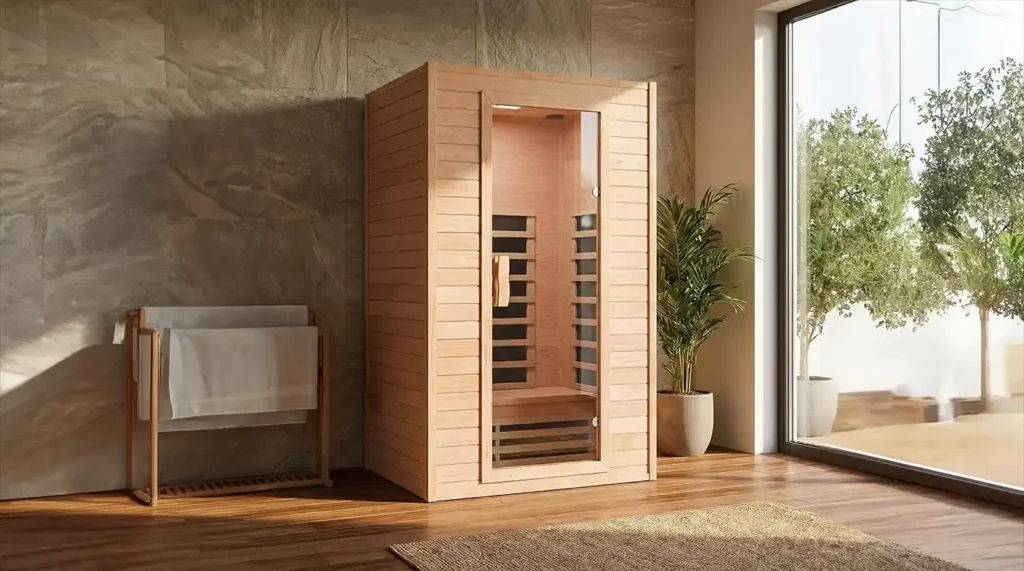
This is the simplest entry point. A plug-in infrared sauna draws around 1,500W on a standard 120V/15A circuit — the same kind of outlet your toaster uses. No electrician is required, no permit is filed, and no panel work is needed. You unbox it, plug it in, and you are done.
The catch is performance. Infrared saunas heat your body differently than a traditional Finnish-style sauna. They run cooler (around 45°C to 60°C versus 80°C to 100°C for a traditional heater) and they do not produce the steam and intense radiant heat that most sauna enthusiasts are after. For some people, that is a perfect fit. For others, it feels like a warm closet.
There is also a circuit load question worth thinking about. That 120V outlet should be on a dedicated circuit — not shared with other high-draw appliances. If your sauna keeps tripping the breaker, it is usually because it is sharing a circuit with a space heater, dehumidifier, or refrigerator. A licensed electrician can add a dedicated 15A circuit for around $400–$600 in most Ottawa homes, which solves the problem cleanly.
Quick checklist for plug-in infrared buyers:
- Confirm the outlet is on a 15A circuit (look at your breaker panel)
- Make sure nothing else heavy runs on the same breaker
- Check that the outlet is in good condition — no scorch marks, no loose fit
- Keep at least 15 cm of clearance around the unit for airflow
We offer free on-site estimates for Ottawa homeowners. We check your panel, measure the run, and tell you exactly what your project will involve — before you spend a dollar on equipment.

Path 2: Hardwired Electric Sauna (240V)
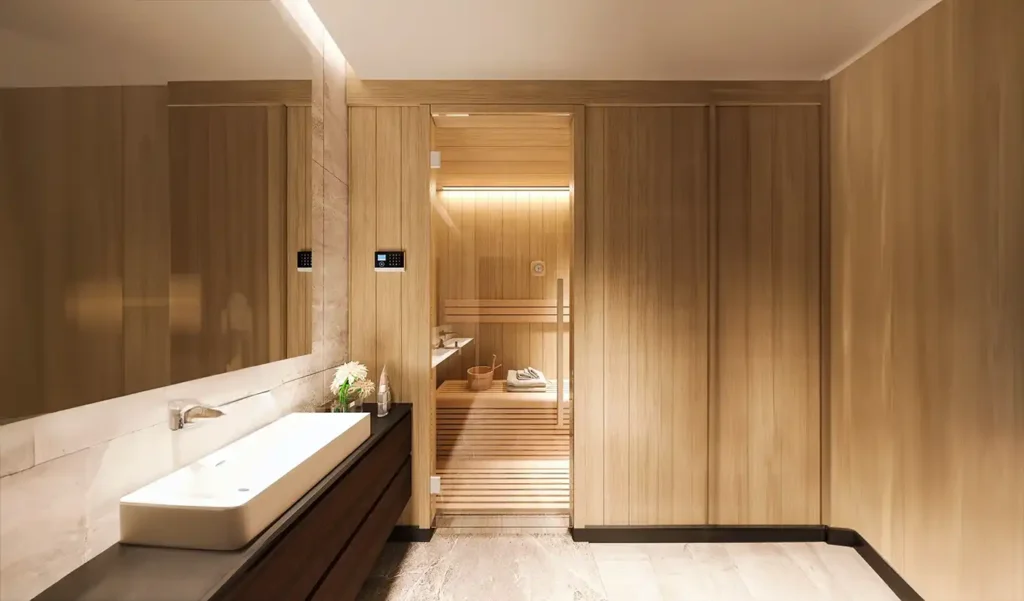
This is where most serious sauna buyers end up. A traditional Finnish sauna or a high-output barrel sauna needs a dedicated 240V circuit — the same voltage as an electric dryer or oven, but with its own set of installation rules.
Heater sizes range from about 3.5 kW for a small room up to 9 kW or more for a large sauna. The circuit amperage you need depends on the heater’s rated load. A 6 kW heater at 240V draws 25A, so code requires a breaker rated at least 150% of that — typically a 40A breaker with 8-gauge wire. Bigger heaters need bigger wire and a bigger breaker. Wire sizing is not something to guess at — undersized wire is a fire risk, and it will fail an ESA inspection.
| Feature | 120V Plug-In Infrared | 240V Hardwired Sauna |
|---|---|---|
| Typical output | 1,200–1,500W | 3,500–9,000W+ |
| Max temperature | ~45–60°C | ~80–100°C |
| Heat-up time | 15–20 min | 20–40 min |
| Breaker size | 15A | 30–60A |
| Wire gauge (typical) | 14 AWG | 6–10 AWG |
| ESA permit required | No | Yes |
| Steam (löyly)? | No | Yes (traditional heater) |
| Typical electrical install cost | $0–$600 | $800–$2,500+ |
One thing that surprises homeowners: the Ontario Electrical Safety Code requires a timed cut-off switch on sauna heaters, set to a maximum of one hour with no override. This is not optional and it is not something you can skip to save money. Every hardwired sauna installation in Ontario needs this control, and it will be checked during the ESA inspection.
There is also a clearance requirement most buyers do not know about. The heater must be kept away from combustible materials, and the space around it cannot be exposed to temperatures above 90°C. If your sauna has glass walls, tile surfaces, or wood framing close to the heater, those factors affect where the heater can legally sit. An experienced sauna installation electrician will check those clearances before a single wire is run.
"The heater area, adjacent to combustibles, cannot exceed 90°C — and the heater must be controlled by a timer that cannot be set beyond one hour." — Ontario Electrical Safety Code requirements, as clarified in the 2025 ESA flash notice on electric saunas.
Path 3: Backyard or Outdoor Sauna

Outdoor sauna demand in Ottawa is growing fast. Searches for “backyard sauna” rose 30% year over year in 2024, and we see it in our quote requests too. The appeal is obvious — fresh air, privacy, no steam in the house. But this path has the most moving parts electrically, and it is the one most likely to produce an expensive surprise mid-project if it is not planned properly.
Here is what an outdoor sauna installation usually involves beyond the sauna itself:
- A new 240V circuit from your main panel (or a subpanel) to the outdoor structure
- Underground conduit or direct-burial cable run from the house to the sauna — typically at least 45 cm deep under a lawn, deeper under a driveway
- A disconnect switch mounted outside the sauna structure, within sight of the heater
- A GFCI breaker for outdoor and damp-location protection
- ESA permit filed before work begins
If your sauna is in a detached structure — a shed, a cabin, a prefab barrel sauna on its own foundation — you may also need a building permit from the City of Ottawa. The exemption applies to one-storey detached sheds under 15 square metres with no plumbing. If your outdoor sauna is larger than that, or if it is attached to another structure, the building permit question needs to be answered before construction starts.
Before you dig: Call Ontario One Call first.
Any time a trench is going into your yard, provincial law requires you to request locates at least 5 business days before digging. This protects you from cutting buried gas lines, water service, or utility cables. Request locates at Ontario One Call → Note: their locates only cover public utility lines. Private lines — like power running to a detached garage — are your responsibility to identify and mark.
The other variable is the wire run distance. A long trench from your panel to the far corner of your property may require a larger wire gauge to prevent voltage drop, or it may make more sense to install a small subpanel in the structure and run a single large feed. We see this situation often in Manotick and rural Kanata properties where the sauna is well away from the house. Your electrician needs to calculate the run before quoting — and any contractor who quotes without measuring is guessing.
We handle the full electrical scope — trench, conduit, disconnect, ESA permit, and inspection. One team, one price, no surprises.
Same-Day Quote
Ottawa Permits: ESA Notification vs Building Permit
This is one of the most misunderstood parts of any sauna project, and it catches homeowners off guard more often than almost anything else.
In Ontario, almost all electrical work must be reported to the ESA through a Notification of Work — filed before the job starts, not after. This is not optional and it is not just for commercial projects. If you hire someone to run a 240V circuit for your sauna, that person must be a Licensed Electrical Contractor in Ontario, and they are responsible for filing the notification. An ESA inspector will then review the work. This is how your installation gets a legal stamp of completion — and it is also how problems get caught before they become fires. Read more about ESA notification requirements →
A building permit is a separate thing entirely. The City of Ottawa does not require a building permit for work that is exclusively electrical. So a hardwired indoor sauna — where an electrician adds a circuit to an existing room — does not need a building permit. What it does need is the ESA notification and inspection.
Can Your Electrical Panel Handle a Sauna?
This is where the conversation either stays simple or gets complicated fast. A sauna heater does not just need a breaker slot — it needs actual available electrical capacity in your home’s service. A 6 kW sauna heater draws the same power as two electric dryers running at the same time. That load has to come from somewhere.
See how adding a sauna circuit affects available breaker space and total panel load.
Load figures are illustrative — based on a typical Ottawa home. Actual availability depends on your specific appliances and diversity factors. A licensed electrician performs a formal load calculation on-site before any new circuit is added. Panel too full? See upgrade options →
Homes with 200A service are generally in good shape. A modern 200A panel serving a typical Ottawa home usually has enough headroom to add a 30–40A sauna circuit without an upgrade, provided there is an open breaker slot and the total calculated load stays within limits. Your electrician will do a load calculation — it takes about 15 minutes on-site and tells you exactly where you stand.
Homes with 100A service are a different story. In an older Ottawa home with a 100A panel, you may already be running an electric stove, electric dryer, air conditioner, electric water heater, and baseboard heaters. Adding a 30–60A sauna circuit on top of that is often not possible without either upgrading the panel or removing another load. It is a conversation worth having before you buy the sauna. If your home needs a panel upgrade, our Electrical Panel Upgrade service page walks through what that process looks like and what it typically costs in Ottawa.
Panel space — open breaker slots — is also a factor. A full panel with no tandem breakers available may need either a subpanel or an upgrade before a new circuit can be added. This is one of the questions we ask during every sauna estimate, and it is one of the reasons we do not quote jobs without a site visit.
Signs your panel may need attention before a sauna install:
- Your panel is a Federal Pacific, Zinsco, or pushmatic brand (known reliability concerns)
- You have no open breaker slots
- You are on 100A service with multiple electric appliances
- Breakers trip frequently under normal household load
If any of these apply, reach out to us for a load assessment before buying your sauna. It is a free call and could save you a costly surprise.
What the 2025 ESA Safety Warning Actually Means for You
In 2025, the Electrical Safety Authority and Ontario’s fire authorities issued a formal flash notice specifically about electric saunas. It is worth reading the plain-language version of what they flagged — because several of the risks they identified are things homeowners cause without realizing it.
The key fire-risk factors the ESA identified were:
- Combustible materials left inside the sauna (towels, wooden buckets, accessories stored too close to the heater)
- Incorrect wiring — undersized wire, wrong breaker size, or no disconnect
- Missing high-limit protection on the heater
- Unapproved replacement parts — buying a cheaper heater stone or thermostat off Amazon
- Heaters installed too close to combustible surfaces, like unfinished wood framing
- Heaters placed under shower heads or water sources
- No timed cut-off switch — or a switch that can be overridden beyond one hour
Several of these risks come from DIY wiring or informal installations — homeowners who hire a general contractor instead of a licensed electrical contractor, or who try to wire the heater themselves using YouTube videos from American jurisdictions where the code is different. Ontario’s OESC is specific about sauna requirements, and the 2025 ESA notice reinforces that. An unlicensed install that causes a fire may also create insurance complications.
The clearest takeaway from the notice is this: a sauna is not a plug-and-play appliance the moment it involves 240V. It needs to be treated with the same seriousness as any major electrical installation in your home. The ESA’s own compliance page is the best starting point if you want to read the rules directly.
Every sauna install includes the ESA notification, a full inspection, and our workmanship guarantee.
Same-Day Quote
What Actually Changes the Price of a Sauna Electrical Install
One of the most common questions we get is: why does the price vary so much? A sauna circuit quote can range from $800 to $5,000+ depending on the project. Here is what actually drives that range.
| Cost Factor | Lower Cost Scenario | Higher Cost Scenario |
|---|---|---|
| Panel capacity | 200A with open slots | 100A or full panel — upgrade needed |
| Wire run distance | Panel is close, short run | Long run across a finished basement or large yard |
| Finished walls | Unfinished basement or open framing | Finished drywall — fishing wire, patching required |
| Outdoor trenching | Not needed (indoor install) | 40–100 ft of trench, conduit, and fill |
| Heater size | 3.5–6 kW (smaller gauge wire) | 9+ kW (larger wire, larger breaker) |
| Subpanel | Not needed | Long outdoor run or detached structure |
| ESA permit + inspection | Included in all legitimate quotes | Never optional — be wary of quotes that exclude it |
The biggest single driver of cost in Ottawa homes is the condition of the panel combined with the length of the run. A sauna in a basement directly below the main panel in a home with a 200A service and open breaker slots is the easiest job we do. The same sauna in a finished living space three floors up from a 100A panel is a fundamentally different project.
If you want to understand how new circuit additions are priced in Ottawa, our circuit installation page goes into more detail on what affects the cost of running wire through different home types.
Choosing the Right Heater Size for Your Room
Heater manufacturers calculate output based on room volume — cubic metres or cubic feet. But raw volume is not the whole picture. Glass walls, tile surfaces, concrete, and brick all absorb and lose heat faster than insulated cedar, which means you need extra heater capacity to compensate.
Cubic feet of adjusted room volume. Add 16 cu ft per sq ft of glass or uninsulated tile.
A simple rule of thumb: calculate your sauna’s interior volume in cubic metres, then add roughly 1.5 cubic metres of “extra” volume for every square metre of glass or uninsulated tile surface. Then match that adjusted volume to the heater manufacturer’s output chart. If you land between sizes, go up — an undersized heater struggles to reach temperature and runs almost continuously, which shortens its life and raises your hydro bill.
Larger heaters (9 kW and above) sometimes require the control box to be mounted outside the steam room, which adds complexity to the wiring layout. This is worth knowing before you fall in love with a particular model — it may change where and how the electrical work is done.
Make the Right Choice Before You Buy
Most sauna buying guides stop at the cedar and the stones. This one starts at the panel — because that is where your project either works or gets expensive fast.
The three paths are real, and each one fits a different homeowner situation. A plug-in infrared unit is the right call for a renter or someone testing the waters. A hardwired 240V sauna is the right call for a homeowner who wants real heat and is prepared to do it properly. And an outdoor backyard sauna is a genuinely great project — but it needs an electrician who understands trenching, disconnects, permits, and load calculations before a single stone is placed.
The electrical work is not a finishing detail. It is the foundation of a safe, legal, long-lasting sauna. Get it right the first time, and you will enjoy it for twenty years. Get it wrong, and you will be explaining it to your insurance company.
If you are ready to move forward — or just want to know what your specific home will need — contact our team for a free, no-pressure estimate. We serve all Ottawa neighbourhoods, and we have been doing this for over 15 years. We will tell you exactly what your project involves before you spend a dollar on equipment
FAQs
Do I need a permit to install a sauna in Ottawa?
For a hardwired 240V sauna, yes — an ESA Notification of Work must be filed by a Licensed Electrical Contractor before the job starts. The City of Ottawa does not require a separate building permit for electrical-only work. If you are adding an outdoor sauna in a detached structure over 15 square metres, a building permit from the City may also apply.
Can I wire a sauna myself in Ontario?
How long does a sauna electrical installation take?
For a standard hardwired indoor sauna with an accessible panel and reasonable wire run, the electrical work typically takes one day. Outdoor installs with trenching may take two days depending on trench length and site conditions. The ESA inspection is scheduled separately after the work is complete.
Will a sauna increase my hydro bill significantly?
It depends on frequency of use and heater size. A 6 kW sauna running for one hour uses 6 kWh of electricity. At Ottawa-area Hydro Ontario rates (roughly 10–13 cents per kWh depending on time of use), that is about $0.60–$0.78 per session. Using the sauna four times per week adds roughly $10–$13 per month to your hydro bill at current rates — not a major concern for most households.
Can my 100A panel support a sauna?
Does an outdoor sauna need its own disconnect switch?
Yes. The Ontario Electrical Safety Code requires a disconnect switch within sight of the sauna heater. For outdoor structures, this is typically mounted on the exterior wall of the sauna or on a nearby post, and it must be accessible without entering the sauna room. This is a code requirement, not optional.
Share on Social Media:
Hey! I’m Matt Fortin, Founder & Master Electrician of Ottawa Electric. I have 20+ years of electrical industry experience across residential, commercial, and heavy industrial work. I lead our team with a focus on safety, quality workmanship, and clear communication.
Table of Contents

Ottawa Electric installs hardwired and outdoor saunas to ESA code. No shortcuts, no surprises.
Same-Day Quote
